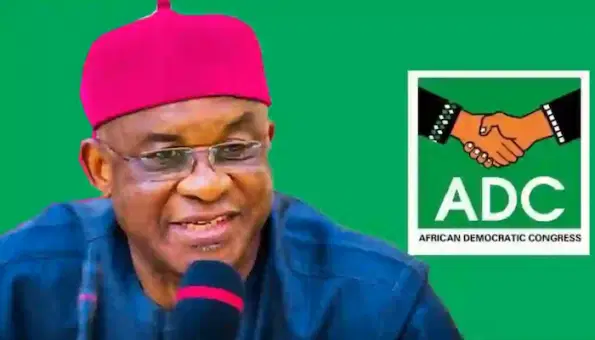
Thursday’s Supreme Court ruling restoring the leadership of former Senate President David Mark may have handed the African Democratic Congress, ADC, a temporary legal reprieve, but it has also exposed the mountains the opposition party must climb, if it hopes to successfully challenge President Bola Tinubu in 2027.
The apex court set aside the Court of Appeal’s earlier status quo order and effectively returned the Mark-led structure to the saddle, while directing parties back to the trial court for hearing of the substantive dispute.
The Independent National Electoral Commission, INEC, has since reflected the changes and returned Mark as ADC national chairman on its portal.
For a party seeking to become the rallying point of Nigeria’s fractured opposition, the judgment was seen as a victory. Yet insiders such as former Vice President Atiku Abubakar warn that the legal triumph may only mark the beginning of a tougher political war and urged party faithful to be resilient and focussed.
Fresh hurdles before ADC
As it is, the party is facing a bouquet of fresh hurdles.
Existential Threat
Yes, Mark is back in the saddle and his leadership recognised by the INEC but he cannot conduct congresses, convention and primaries to select party candidates.
Reason: The judgement of a Federal High Court led by Justice Joyce Abdulmalik not only voided recent congresses of the party but also, by an order of perpetual injunction, restrained the ADC “from organising state congresses, or any Congress or convoke national convention.”
Therefore, the ADC must successfully appeal this ruling up to the Supreme Court. Given the tight 2027 poll timelines of the INEC, it will take a miracle for the ADC to surmount this hurdle.
For a start, all parties must submit their membership registers to the INEC on or before May 10. Parties have July 11, 2026 that is exactly 70 days from today to upload their presidential and National Assembly candidates’ names on the INEC portal
Mark must also return to another Federal High Court presided by Justice Nwite, where factional chairman, Nafiu Bala Gombe, is challenging his leadership. The apex court ordered that he should return to the lower court for hearing.
Speaking on these issues on Wednesday, Mark said the party would challenge the issues in court and assured that the ADC would be on the ballot in 2027. It is to be seen if his assurance will come to pass.
However, 2023 Presidential Candidate of the party, who is backing the Temitope Ogga-led faction, Mr Dumebi Kachikwu, insists that his camp would have the last laugh over the Mark and Gombe camps.
Kachikwu said the Supreme Court displayed biblical King Solomon’s wisdom in refusing to be used as a tool of destabilisation by the Mark-led group when it directed both factions to return to the trial court.
His words: “In vacating the order of status quo ante bellum all the Supreme Court has said is that they are not stopping any of the factions from calling themselves any name they choose to call themselves, but they should allow the lower court to determine if any of the two factions is the rightful leadership of the ADC.
“In the case of Nafiu Bala Gombe and the David Mark band of adventurers, we know that none of the two parties has rightful claim to the leadership of the party.”
Battle of presidential titans
Apart from existential threat, the ADC now faces what many call its most delicate challenge — choosing one candidate from a crowded field of heavyweights.
Names linked to the race are former Anambra State Governor and 2023 Labour Party Presidential Candidate, Mr Peter Obi; 2019 and 2023 PDP Presidential Candidate, Alhaji Atiku Abubakar; former Kano Governor Senator, Dr Rabiu Musa Kwankwaso; former Rivers State Governor and Transportation Minister, Mr. Rotimi Amaechi; and Mohammed Hayyatu-Deen.
Each commands a regional base. Each has loyalists. Each believes he can win.
The danger for ADC is simple: if the primary becomes bitter, losers may walk away — repeating the old Nigerian opposition cycle.
And unlike in the past, those who walk way may not have a platform to contest giving the INEC’s tight timelines and provisions of the 2026 Electoral Act.
To be able to contest on any party’s platform, your name must be on the membership register to be submitted on May 10, exactly eight days from today.
Currently, underground moves in the ADC have produced two tendencies. While some are rooting for Obi/Kwankwaso presidential ticket, some are for Atiku/Makinde or Atiku/Amaechi ticket.
Governor Seyi Makinde of the People’s Democratic Party, PDP, is yet to defect to the ADC.
Last week ADC top shots including Atiku, Obi, Amaechi, Mark, and Aregbesola met him in Ibadan, the Oyo State capital for a summit.
After the summit, they pledged to present a single candidate against Tinubu, next year.
Who is this single, consensus or joint candidate? That is the tough nut ADC and opposition leaders must crack urgently to beat INEC’s deadline.
STRENGTH of ASPIRANTS
Peter Obi
Still commands strong urban youth appeal and South-East loyalty. But must build northern bridges and wider structures.
Atiku Abubakar
Experienced and nationally known, with deep networks. Yet age, repeated bids and fatigue narrative remain hurdles.
Kwankwaso
Strong Kano base and disciplined following. But national spread remains limited unless alliances deepen.
Amaechi
Seen as experienced and combative. Needs mass emotional connection and stronger grassroots momentum.
Based on their current rating, some insiders favour an Obi/Kwakwanso ticket, which they claimed is “making the presidency jittery.”
According to them, the ticket enjoys the backing of many youths, professionals and retired generals across the country.
However, the Atiku/Makinde or Atiku/Amaechi is said to have attracted the support of some ADC leaders from the South-West and the North and may prevail in the event of direct primaries.