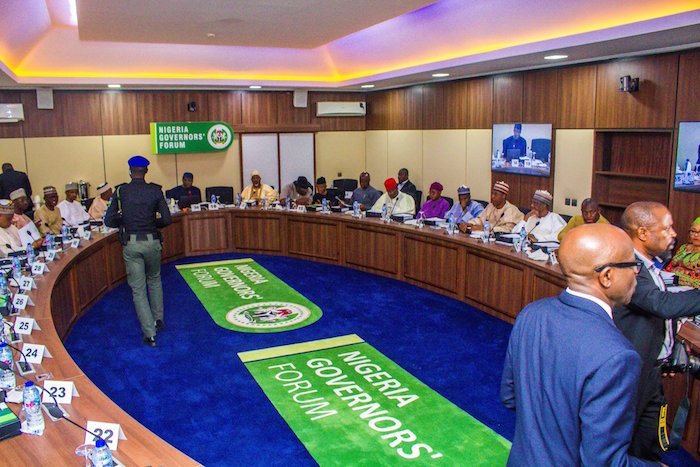
In 2021, State governors and local government chairmen in the 36 states of the Federation collected over N375 billion from public coffers in the name of security vote, an act not provided for in the Nigerian constitution or any known law in the country. This amount excludes those the president and other top government officials collected in the same year, nor does it include what is appropriated for internal security or the budget of the police and security agencies. The security vote, often provided in cash to governors, is not subject to legislative oversight or independent audit and therefore disbursed at the Governor’s discretion. Regrettably, despite the enormous sums of money they collect from the public treasury, state governors have been incapable of stopping wanton killings, kidnappings, inexplicable security breaches and other criminal activities in their states.
Security vote is a monthly opaque allowance allocated to state Governors to fund non-classified security expenditures within the states. The monthly fund runs into billions of Naira and varies based on the level of security intervention required by the individual state or the level of influence the Governor wields over the legislature. Some states collect as much as 24 billion annually, and others less. The level and quantum of security vote is a function of the perceived security cum political threat a state is exposed to. The governors are not alone. Chairmen of local government areas also collect security votes that they treat as personal entitlement or funds. The worrisome aspect of this practice is that there is no limit to, or regulation of what governors may spend as a security vote, and, sadly, the amount involved may be appropriated. However, the expenditure is never subject to legislative scrutiny or accountability. Instead, the allocation and use of the amount involved are usually shrouded in secrecy. In fact, the Court of Appeal in the case of FGN versus Jolly Nyame posited that failure to give an account of security votes amounts to stealing or criminal misappropriation, akin to genocide.
Prevalent data shows that in one year, this in-cash, opaque spending exceeds 70 per cent of the annual budget of the Nigerian Police, more than the Nigerian Army’s annual budget, and more than the Nigerian Navy and Nigerian Air Force’s annual budgets combined. This excludes the personnel cost of the military services. For instance, the 2018 budgetary allocation to defence headquarters was N145 billion, while funding to the Ministry of Interior was N63.26 billion—the total falls short of N241.2 billion the governors spent under the amorphous subhead “security vote” in that year. Admittedly, the security agencies’ budget has spiked in the past three years, driven by multiple factors.
Last week I read both in the conventional and online media about a meeting with anti-corruption agencies, at the instance of the Nigerian Governors Forum, to discuss the issue of security vote. The motive was unclear, especially coming at a time of transition to new governors. It might not be unconnected with outgoing governors looking for a shield from being harassed by anti-corruption agencies after leaving office on May 29. We cannot dispute that the “security vote” is more of a myth, mystery, or tale than a public interest issue. It is the most shrouded secret expenditure in government circles. However, the funds are public resources, so the people deserve to know how every Naira is spent and the value derivable.
There are two schools of thought on the issue of security votes. On the one hand, the hypothesis is that in third-world countries, absolute transparency is impossible in government. We must do certain expenses under the table to ensure societal stability, and we cannot capture such expenditures done in the public interest by the Governor within any accountability framework. A second and opposing school of thought contends that public money is at stake, so it must be accounted for. And those public funds, if not accounted for, will always be subject to abuse. Both schools raise pertinent issues for interrogation, and this has become more urgent just before new governors take over the reign of governance and continue with a convention that has yet to serve any purpose.
At a time, we are witnessing governors withdraw several billions in cash, state accounting books not being tidy, some states spending as much as 10-15% of the annual budget on security votes without any form of accountability, and services nosedive in states yet security votes keep rising, the need to balance public interest, practical reality and abuse becomes imperative.
One condition that has inadvertently worked for the Governors is that people prioritise increased security over transparency and accountability in the face of high levels of insecurity. Therefore, we subordinate the need for accountability in finance to the desire for improved security. Without accountability and transparency, it is not difficult for governors to exploit the concept of state security to pilfer from the public purse. This is undoubtedly true in many states in Nigeria, where the deteriorating nature of the security of individual lives and property has ensured the existence of little or no public opposition to all manner of government proposals aimed at improving state security.
In turn, high levels of crime and disorder have facilitated the ballooning of security vote, the abuse of which is achieved by creating a black box around the concept of state security under the pretence that absolute secrecy is required when it comes to the allocation and spending of resources to tackle insecurity. The abuse and misuse of security votes in Nigeria have grown alarmingly in Nigeria’s 23 years of democratic interregnum. The tendency among Nigerian politicians, particularly the executive arm at the state levels of government, to manipulate security issues for political and economic gains is widespread. A former EFCC Chairman alleged that some governors deliberately fuel insecurity in their states to provide oxygen for more security votes.
Pertinent rhetorical questions arise: Is the security vote of governors a statutory stipulation? Is it provided for in the constitution, the financial guidelines, or general orders? How much should it be as a percentage of state GDP, presumed security needs of individual states, and population? Who audits and controls security vote appropriations? Should governors have access to state funds above the requirements of public accountability?
Although governors have no responsibility for the country’s security apparatus at the state level, the constitution recognises them as chief security officers of their respective states. However, the worsening security situation in the country has justified governors to demand an increased role in the security of their states. Some governors have argued that the legislature should amend the constitution to give them more control and power over security issues within their state.
Because the entire budgeting process and operating mechanics of security votes are shrouded in secrecy, a consequence of the rentier nature of the Nigerian state and its underdeveloped democracy, there is little pressure to justify such expenses and subsequent increases to the electorate. The secrecy surrounding issues of state security and the nature of security votes provide an alibi for state governors in their attempt to evade allegations of corruption and disguise their pilfering from the public purse.
EFCC has recently expressed concern about states hiding under security votes for all sorts of infractions, including using state money to sponsor violence against her people, using state funds for personal projects and siphoning funds for other political and party interests. The critical issue is how do we justify the continued relevance of security votes, a carry-over culture from the military regime when all security agencies are under the federal government? How do we constructively balance public interest, proper accountability framework, probability of abuse, and practical reality without compromising general security? Is it high time we tackled this issue of security votes before the next set of governors sacrifices tangible development on the altar of security votes?
In some quarters in Nigeria, the perception that governors should not account for security votes needs to be revised. This is so because the Nigerian Constitution invests the legislature with the power to oversee the audit of all government accounts, including security votes. The fact that the legislature has failed to do this in the past because of incompetence or compromise does not change this fact. Security votes have become a convenient tool for disguising these governors’ looting of the public purse. This lack of accountability has continued unabated even though the 1999 Constitution contains sufficient safeguards to prevent such abuses. The problem is rooted more in the rent nature of the state than the inadequacy of the laws and constitutional provisions to mitigate it.
Granting that there will be expenditures incurred by governors outside the budget provisions, how do we accommodate these? Issues like the emergency medical evacuation of notable citizens, emergency distress assistance, and donations to good causes need to be provided for since they will always come up. We must create a core subhead for these in each Governor’s office so that expenses can be retired, and due accounting processes observed. The term’ security vote’ is, therefore, a misnomer. We should create a new terminology to cover the financing of emergencies of the state, including support to security agencies that are accountable and not open to abuse. The Nigerian states should critically examine how states in matured democracies deal with budgeting for emergency expenses that are accountable and legal. The legislature constitutionally granted the oversight role against the executive must reconsider the security vote and either remove them entirely or allow a reasonable amount (about 1% of the budget) for emergency security issues. And the governors must account for it.
ABOUT THE AUTHOR
Peterside, former DG, NIMASA, writes from Port Harcourt, Rivers State