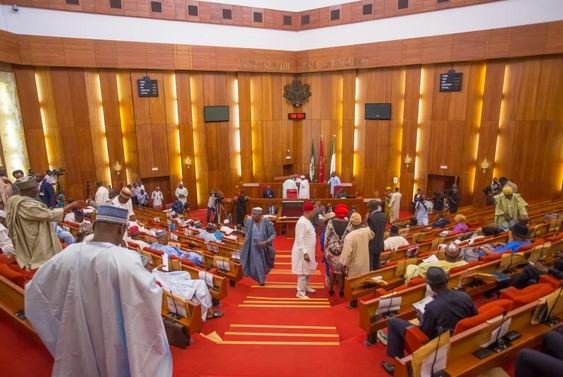
In an epoch-making session that fundamentally alters the geopolitical and security landscape of the nation, the Senate, yesterday, passed a landmark constitutional amendment bill establishing state police across the 36 states of the federation.
The passage of the executive bill, transmitted to the National Assembly by President Bola Tinubu, officially sets the stage to dismantle the decades-old unitary structure of the Nigeria Police Force, NPF, and replace it with a dual model, comprising the Federal Police Service and State Police Services.
The high-stakes legislative exercise, however, suffered a major technical hitch, that for over 30 minutes, the hallowed chamber’s electronic voting system crashed, forcing the lawmakers to adopt the manual method. In an unusual spectacle, all 88 lawmakers present voted by a physical show of hands.
The tension in the chamber was palpable as technical engineers scrambled frantically to revive the voting portals.
Realising the clock was ticking on a piece of legislation that has evaded previous assemblies since the return to civil rule in 1999, Senate Leader, Senator Opeyemi Bamidele, APC, Ekiti Central, moved a motion to ditch the faulty technology.
The motion was swiftly seconded by the Senate Minority Leader, Senator Abba Moro, PDP, Benue South, paving the way for the historic manual show of hands.
Power stripped, safeguards installed
To douse long-standing fears that state governors might weaponise local police formations against political opponents or ethnic minorities, the passed bill (Sixth Alteration Bill, 2026, SB. 1055) introduces unprecedented constitutional firewalls and stringent accountability metrics.
According to the comprehensive report of the Senate Committee on the Review of the 1999 Constitution, chaired by Deputy Senate President Jibrin Barau, APC, Kano North, no state can arbitrarily launch its police force unless certified by the National Assembly as meeting rigorous “national minimum standards.”
Crucially, under the newly substituted Section 214 of the Constitution, the Federal Police Service retains absolute monopoly over major security sectors, ensuring that the federal government remains the ultimate custodian of the nation’s territorial integrity. The Federal Police will maintain exclusive jurisdiction over National security, terrorism, and cybercrime; inter-state crimes, arms-trafficking, and international crime syndicates.
The policing of the Federal Capital Territory (FCT), Abuja, and federal institutions.
The bill clarifies that while state police will manage domestic public safety, they are completely barred from cross-border law enforcement. A State Police Service shall not exercise police powers outside the borders of the state for which it is established, except as specifically authorised by an Act of the National Assembly.
Section 214: Dual policing legal blueprint
Section 214 provides: “(1) There shall be a police service for the Federation to be known as the Federal Police Service. (2) There shall be established for each State of the Federation a State Police Service subject to this Constitution and an Act of the National Assembly. (3) No State Police Service shall commence operational policing unless it has been established by a Law of the House of Assembly of the State and certified as meeting national minimum standards in the manner prescribed by an Act of the National Assembly.”
How FG can seize state police
One of the most intensely debated aspects of the bill centres on the federal government’s veto power to override state control. The legislation empowers the President to bypass state governors and temporarily assume direct operational command of any State Police Service under strict exceptional metrics.
The conditions under which a federal takeover can occur are explicitly detailed to prevent arbitrary federal interference, while ensuring that rogue or incapacitated state police forces are quickly brought to heel. These triggers include:
“(a) Where there is an actual or imminent breakdown of public order or public safety which the State Police Service is unable or unwilling to contain;
(c) The State Police Service is unable to function by reason of serious administrative, financial, operational or other incapacity…
(d) There is substantial evidence that the State Police Service is being used for egregious or systematic violation of fundamental rights, partisan or electoral intimidation, ethnic, religious or sectional persecution, or unlawful obstruction of this Constitution…”
The bill stipulates that such federal interventions must be authorized in writing by the President, explicitly stating the grounds, targeted territory, and expected duration of the takeover. Furthermore, a formal notice of the intervention must be transmitted to the affected State Governor, the Speaker of the State House of Assembly, the National Police Council, and the National Assembly within 48 hours of execution.
To prevent indefinite federal occupation, the bill notes that no intervention can continue beyond a period prescribed by the National Assembly, and must be validated by a resolution supported by the Senate. Crucially, the legality, scope, and duration of such look-ins remain fully subject to judicial review by the courts.
The historical gravity of the debate drew powerful political figures to the Senate gallery, creating a packed house as lawmakers deliberated on the principles of the bill.
Among those present to observe the historic vote were the Chief of Staff to the President, Femi Gbajabiamila; Governor Uba Sani of Kaduna State; Governor Dapo Abiodun of Ogun State; and Governor Lucky Aiyedatiwa of Ondo State.
They were accompanied by a high-powered delegation of state Attorneys-General from across the federation, including those of Anambra, Akwa Ibom, and Ondo states, alongside the Director-General of the Nigeria Governors’ Forum, NGF, Dr. Abdullateef Shittu.
Lead debate
Leading the debate earlier, Senate Leader, Opeyemi Bamidele, argued that the existing highly centralised federal system was structurally overstretched and ill-equipped to address localised threats such as banditry, kidnapping and communal clashes.
“By establishing concurrent jurisdiction through the formal creation of state police services alongside the existing Nigeria Police, this decentralised framework aligns with the core principles of true federalism.
“It empowers subnational authorities with local knowledge and cultural competence necessary for rapid response and effective intelligence gathering,’’ Bamidele stated.
Guarding against political abuse
To insulate the leadership of both policing tiers from political manipulation, the bill introduced a rigid tenure system and strict guidelines for the removal of police chiefs.
The Federal Police Service will be headed by an Inspector-General of Police appointed by the President on the advice of the National Police Council, subject to Senate confirmation.
Conversely, the State Police Service will be headed by a Commissioner of Police appointed by the governor on the recommendation of the National Police Council, subject to confirmation by the State House of Assembly.
Crucially, neither the IGP nor a state Commissioner of Police can be whimsically suspended or removed from office by the executive arms of government. Removal can only be triggered for “stated cause” in accordance with a fair hearing, and must be approved by a two-thirds majority resolution of either the Senate (for the IGP) or the respective State House of Assembly (for a state Commissioner).
Furthermore, Section 215(7) places a strict prohibition on political directives: “No direction under this section shall require the arrest, detention, investigation, non-investigation, deployment or use of force against any named person, political party, association or class of persons except in accordance with law; or require a police service… to suppress lawful political activity, discriminate against any person or group, or enforce the law for a partisan, ethnic, religious, sectional or personal purpose.”