Opinion | By Dakuku Peterside | 16. 05. 2022
Nigeria is at a tipping point regarding security, human capacity development and economic growth. However, the biggest challenge we face as a country is not about the challenges of today but a bleak future stirring Africa’s biggest economy and the most populous Black nation in the face. Looking beyond the 2023 general elections, one sees our leaders’ deliberate insensitivity and indifference at various levels to the destruction of one sector that offers us hope to safeguard and recover the future. That sector is the educational sector.
In the last month, Nigeria’s education sector crisis has become more evident – ASUU, which has been on strike since February 14, 2022, has extended the same by three months. ASUP, the Union of Polytechnic lecturers, have commenced strike action. There is zero public school registration for WAEC in Sokoto and Zamfara states, and some candidates in some southeast states cannot participate in UMTE examinations due to IPOB sit-at-home orders. There are other horrendous developments in the education sector. What is freighting is the inability of our policymakers to connect the monumental rot and negligence of the education sector today to our bleak future.
Nigeria seems to be retrogressing in all aspects of education and skill acquisition. The net quantity and quality of education in Nigeria compared with past decades, given our population and economy, is negative. The products of our education system cannot measure against their opposite numbers in India , China or the EU.
The education sector crisis has been made worse by the intractable insecurity in various parts of Nigeria, the girl child education inequity, and poverty that has made quality education unaffordable to many Nigerians. There is total loss of confidence by stakeholders in our education system.
Loss of confidence in Nigeria’s education is led by the political and other elite class . Over 95% of the elite leaders in government, business and technocratic professions are educating their children in tertiary institutions in Europe and the US. Consequently , there is hardly any serious policy discussion about education in Nigeria.
Despite notable interventions of the UNICEF and the Nigerian government, we still have 18.5 million children out of school in the country, the second-largest number in the world.
Neglecting the education of the present generation of Nigerians would, in many ways, endanger the prosperity of the future. But does anybody care? Educating young people today will determine how much progress we make as a country. It is evident that with the neglect or near-total collapse of education, the future of our society is uncertain or may be gloomy.
Our education sector needs quantum overhaul that targets educational outcomes. We need improvement starting from primary education, where we see many children out of school. Secondary education needs a total overhaul, where we see declining standards and low attainment in national exams like NECO and WAEC. The complete collapse of the higher education sector, where workers have incessant strike actions, leading to half-baked graduates who are grossly untrainable and unemployable, needs immediate attention.
Education has suffered from insecurity at the basic primary and secondary levels in most parts of the country. The “unknown gunmen” and IPOB agitators have terrorised the southeast and forced a Monday sit-at-home. This problem has affected schools in the five southeast states where 20% of education is not provided each week . Students in southeast states missed examinations scheduled for Mondays nationally during necessary national examinations like WAEC, NECO and UMTE.
As if this is not shocking enough, in Sokoto and Zamfara states, students in public schools did not register for the WAEC examination this year either because the government did not pay, or they are not writing the examination because of various mitigating factors. This anomaly indicates retrogression in teaching, learning and examination for certification.
In other parts of the North, the uptake of the WAEC examination is minimal, even with some state governments paying for the students. Students in IDP camps are worrying more about survival than getting an education. Government poorly funds most government schools, and they owe teachers’ salaries.
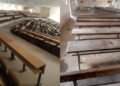
Most government schools in the south of Nigeria are overcrowded and always attended by children from poor backgrounds who could not afford the prohibitive cost of private primary and secondary education for their children.
As the crisis in the education sector deepens, the attention of our political leaders swings between elections and politics. Elections and politics are essential and must receive due attention, but that must not detract attention from the education sector, which is undergoing decay and needs urgent and immediate attention.
It is disturbing to note that the generation that had good government-funded basic education in the ‘80s and ’90s is struggling to function productively nowadays; how much more will the children of this generation with poor education or no education in some cases, become productive at all. The irony is on all of us.
The rich and middle class have insulated themselves from this problem. Children of people in these classes go to private schools abroad or private schools at home, which continues to widen the gap between the poor and the rich and invariably creates inequality .
The children of the poor are hard done. In the past, education was the greatest leveller. Children of the poor often meet and outcompete children from affluent backgrounds in schools. They learn the confidence that comes with knowing that they are as good as anybody with hard work and intelligence, no matter their family background.
Our tertiary education sector is comatose with ASUU, and ASUP strikes. The students are unproductive at home or sometimes a nuisance to their communities. Imagine the impact on the quality of education of these students.
Governments at all levels have an indifferent attitude towards the educational crisis in the country. They have not articulated better ways of managing education to provide needed quality education for our children. Education policies are either not fit for purpose or not yielding the desired results, and education monitoring institutions are moribund at best where they exist.
It is disheartening that private education providers buy and sell quality education in many states. In some middle class and working-class families, tuition fees and other school-related charges take a chunk of their income.
The recommended average percentage of GDP on total government and private expenditure on education is 5% of the GDP. Most countries in the developed world spend even more than this average on education. For example, “among the 34 OECD countries reporting data in 2015, 17 countries spent more than the average percentage (5%) of GDP on total government and private expenditures on education institutions for OECD countries. Norway spent the most on education as a percentage of GDP at 6.4%, followed by New Zealand at 6.3%, the United Kingdom at 6.2%, and the United States at 6.1 percent,” according to UNESCO. However, data from UNESCO also shows that education expenditure (% of GDP) in Nigeria was 0.85% as of 2017. This statistic shows the crass negligence our education sector is facing from all sections of the government. This must change!
Two futures are possible with our political leaders’ indifference to education issues. The first is where we continue to relegate education to the rear of our development agenda; our youthful population, which ought to be a demographic advantage, becomes a burden. We will entrench and reinforce generational inequality and possibly poverty, insecurity, and most importantly, dismantle the building block of the future. Conversely, we are setting our country up for endless, perennial crises because of the collapse of essential building blocks of a functional society. Either way, we cannot win.
We know that the growth of the human mind and the broadening of the human intellect reflect his immediate environment’s physical development. Therefore, the development’s physicality is just a reflection and reification of the extent of our mental and intellectual development. This idea underscores the importance of training and education as a key to societal growth.
We see this in what happens to a developed environment when undeveloped minds are allowed to inhabit them, and they trash them and reduce the place to the extent of the level of development of their minds and converse is the case too. This fact underscores the importance of education to the development of Nigeria.
The children we do not educate today will pose a danger in the future, and they may fuel insecurity, criminality, and total dependency on the state for survival, not to mention the lost opportunity cost in productivity they would have given were they educated. Now is the time to pay attention and call for a “state of emergency” in our education sector.
We must bring all ideas, talents, skills, and resources to the table to resolve some of these crises threatening to mar the future of the next generation of Nigerians. It is not just a policy and monetary issue. We need to focus on teacher education to improve the quality of teachers and periodic testing and retraining. Teachers’ promotion will be tied quality of their teaching, personal development, and impact of teaching on students. We need to provide them with the teaching resources and incentives they need to do a good job. Individual states should set independent standards for teachers’ accreditation in their jurisdictions.
We must provide all forms of financial and psychological incentives to teachers. We must ringfence their benefits and emoluments in both federal and state budgets and never allow a situation where the government owe them salaries. Teachers’ reward must be here “on earth and not in heaven.” We should pay them wages when due and pay them a living wage. We must review teachers’ pay based on current economic realities and attract the best to the teaching profession.
The future we want to build for our children will be worse than what we have now if we do not prioritise education. A stitch in time, they say, saves nine. We must focus and refocus all our physical and intellectual energies to rescue our education from total shambles and, that way, safeguard the future we desire.
•Dakuku, former DG NIMASA, lives in Port Harcourt, Rivers State.