Last week’s column took state governors to task, and the response was electric: inboxes flooded, phone lines buzzed, and hashtags trended. Nigerians are starved for public office scorecards that rely on more than rumour and partisan noise. In that spirit, and with the second anniversary of the 10th National Assembly staring us in the face, the spotlight now swings toward the legislature. In Washington, where we borrowed our presidential model, lawmakers live under the unforgiving glare of the Legislative Effectiveness Score: fifteen indicators that weigh everything from the originality of bills to the art of steering them through committees. Add the Healthy Congress Index (HCI), which checks the institution’s pulse—how often it debates and how transparent the votes are—and you have an ecosystem where inertia is quickly shamed. Abuja, by contrast, offers no such dashboard. All we possess are lofty promises voiced from the rostrum on Inauguration Day and the quiet, often-seething expectations of 220 million citizens. Those promises form the spine of this mid-term review; those expectations supply its moral urgency.
First, the numbers. In its opening year, the Senate introduced 464 bills and passed 19; in the second year, up to this May, 341 bills produced a meagre seven enactments. The House looked busier—1,727 bills filed by December 2024, 114 of them passed—but peel away the seven executive-sponsored measures and the apparent productivity deflates. Committee clerks admit that roughly one-third of all texts are recycled from earlier parliaments, some lifted almost verbatim from the 8th and 9th Assemblies. It is legislative déjà vu: copy, paste, rename, re-announce. Quantity, yes. Originality and rigour, no. This Assembly would languish in the bottom quartile by the American yardstick that prizes innovation and shepherding skill.
The quality deficit shows up in what lawmakers choose to rush. The National Anthem Bill of 2024—re-introducing the 1960 song “Nigeria, We Hail Thee”—sailed through first, second and third readings in a single sitting, then became law within eight days. Critics wondered why a symbolic lyric change earned lightning attention while food-price bills languished. A similar haste-then-rethink story dogs the Students’ Loan Act: passed in 2023, repealed and reenacted in 2024 after design flaws emerged. Speed seems reserved for headline bills and presidential priorities; everything else becomes legislative traffic.
If legislative output has been underwhelming, economic stewardship has been positively somnolent. The economy has seesawed from subsidy removal through currency free-fall to inflation that makes a mockery of monthly pay slips, yet Parliament has rarely mounted an independent critique of budgets, revenue forecasts or tax proposals. Hearings on the 2025 Finance Bill—an instrument that will decide whether families stay afloat or sink—featured more cabinet ministers than civil society witnesses. The optics are unmistakable: the legislature has abandoned its role and now promoting the agenda of the executive . The National Assembly held just two stand-alone debates on monetary or fiscal strategy and rubber-stamped the record-sized 2025 budget in 31 sitting hours—barely one-third the time the 8th Assembly devoted to the smaller 2016 estimates.
Where the economy goes, social misery follows. Nigerians now speak of poverty, food prices, banditry, kidnappings and unemployment as if they were the weather—inescapable, ever-present, uncaring. One might expect a flurry of poverty-reduction bills, police reform blueprints, or social welfare overhauls. Instead, the Order Paper remains eerily devoid of landmark initiatives. The lone poverty-relief measure that did clear both chambers has been trapped in the harmonisation mill for half a year, gathering dust while food queues at all gatherings lengthen.
Public sentiment is matching the numbers. Citizens have noticed. A media sentiment scan across 18 dailies found a 72-per cent negative slant toward the Assembly this year. The latest Afrobarometer country brief finds that only 19 % of Nigerians trust National Assembly “somewhat” or “a lot,” a figure lower than the police and barely above political parties. In an era when Instagram comedians draw bigger live audiences than oversight hearings, that statistic feels less like survey data and more like lived reality.
When the Policy and Legal Advocacy Centre( PLAC) set out to gauge public faith in National Assembly, its findings were bleak: confidence in the National Assembly hovered near rock bottom. Wanting to test whether that verdict was an outlier or a mirror, I sifted through months of news coverage and then spoke, quietly and without a script, to two hundred Nigerians spread across markets, campuses and motor parks. Their verdict echoed PLAC’s numbers—distrust has hardened into something close to resignation. The Speaker of the HOR, writing in the Guardian, conceded that Parliament must “earn back the people’s faith.” It takes no political genius to decode that sentence: the legislature’s legitimacy is in free fall, and even its highest officers can feel the rush of air.
Why the distance? Many civil society voices point to the Electoral Reform Bill, which should sit at the heart of any democracy worth the name. Instead, it idles on committee desks, adjourned and re-adjourned while more photogenic bills leapfrog it on the order paper. Electoral rules shape everything else—how leaders are chosen, how accountable they feel, and how national resources are shared. Treat that foundation lightly, and the cracks spread into every social and economic wall we’re trying to shore up. Until lawmakers urgently confront that truth, the trust deficit they bemoan will only widen.
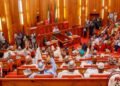
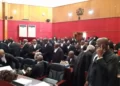
Another reason for that collapse is the anaemic quality of debate. Plenary sittings open without forming a quorum. Though you have 100 per cent attendance on the register, the Senate hardly witnesses more than 40 persons on the floor. The House of Representatives (HOR) is worse; not more than 50 members are out of 360 on a good day. Bills often sprint through first and second readings in minutes. Committee rooms—those sweatshops of legislative business —registered a mere 14 investigative hearings in two years, compared with 61 during the equivalent stretch of the 8th Assembly, confirming that the watchdog’s bark now registers as a whimper. Civil society groups invited to testify say draft bills sometimes arrive the night before or not at all. Oversight this thin cannot scarify an errant minister, let alone a recalcitrant bureaucracy.
Institutional reform, loudly trumpeted on inauguration day, has suffered the same fate. The presiding officers promised digital voting boards, live attendance logs, televised committee sittings and a root-and-branch rewrite of the standing orders. Two years later, the boards are dark, the logs are unpublished, the cameras are absent, and the rulebook is “with consultants.” Promises postponed are promises broken. Misuse of voice voting for a serious national issue, such as declaring a state of emergency in Rivers state, screams of a National Assembly ready to sell its soul for the “porridge” of the Executive.
And then there is money—the ₦6.9 trillion worth of projects smuggled into the 2025 budget, spanning a staggering 11,122 individual schemes. There is no need assessments, community consultations, or GPS-tagged disclosure of location —just pork-barrel politics on a scale large enough to feed an ark. This total legislative add-on is above the combined capital votes of health and education. Just imagine that!
Civil society trackers can find locations for barely a quarter of the projects, procurement portals list even fewer contractors. The optics feed a perception of “Legis-looting” so potent that 21 citizens have already sued the presiding officers for budget opacity, while anti-graft agencies circle but have yet to pounce.
Patterns emerge: a recycling culture that dilutes policy innovation; deference to the Executive that hollows out checks and balances; token oversight that lets scandals slip through the net; opaque spending that deepens the conviction that everyone under the dome is on the take. Each pathology feeds the next like cogs in a depressing machine.
What to do? Borrow, yes—but not mindlessly—from the United States. The National Institute for Legislative Studies could design a Nigerian Legislative Effectiveness Index in concert with civil society and the media, weighting originality, cross-party sponsorship, committee diligence and real-world impact. Every bill should face a “rigour filter” before the second reading: a clear problem statement, a fiscal note, and evidence of stakeholder consultation.
Constituency projects could be forced into the sunlight by a public, geo-tagged dashboard that lets citizens upload smartphone photos of progress—or the lack thereof. Committees deserve independent counsel, research budgets and minority-party chairs for at least 30 per cent of probes, reversing the rubber-stamp culture. And National Assembly must anchor quarterly, nationally televised debates on the economy, timed to the budget cycle, forcing lawmakers either to defend fiscal choices or fold under the klieg lights.
None of this is utopian. All of it is achievable. The 10th National Assembly is not the laziest in purely numerical terms—thousands of bills tell that story—but by any honest qualitative yardstick, it is the least consequential in a decade. Nigeria’s cascading crises require a legislature that legislates, scrutinises and inspires confidence. The good news is that redemption is still possible; the bad news is that the window is shrinking by the week. Citizens have started counting the seconds aloud. Whether lawmakers can still convert this chorus of disillusion into a spur for reform will decide not only the legacy of the 10th Assembly but also, in part, the trajectory of Nigeria’s fragile democracy.
Two years remain. That is enough time to pivot from legislative theatre to legislative therapy: subject every new bill to rigorous stakeholder input , schedule quarterly macro-economy debates that cannot be waived; and adopt a Nigerian-tailored Legislative Effectiveness Index data. These and not outrage should drive the end-term review. Until such reforms take root, the 10th National Assembly’s legacy risks being summed up in one brutal statistic—nineteen per cent.
ABOUT THE AUTHOR:
Dakuku Peterside, former DG of NIMASA, lives in Port Harcourt, Rivers State.