Since man became aware of himself and realised that whether by mutual arrangement or contrived by nature, there are always leaders and followers, communities fashioned out ways and means in which to live together under organised systems to regulate and conduct their affairs.
From primitive father figure leadership to the animalistic instinct of the strongest leading the flock, man has experimented with many ways in which to live in harmony with one another and with the larger community.
Since then, nations have tinkered with various forms, some of which developed into an absolute monarchy (absolutism), limited monarchy (constitutional monarchy), direct democracy and representative democracy. Others are dictatorship, oligarchy, totalitarianism and theocracy.
The presidential system of governance, on which we based our 1979 constitution, and first practised in governance that year, is modelled after the American system.
The presidential system is based on a tripod – the executive, legislature and judiciary, with the head of government, called the president, leading the executive branch. It is both a democratic and republican system of government with fixed tenures for elected officials.The presidential system of government is seen as democratic because the electorate directly elected the president and is, therefore, directly answerable to the people. There is also effective control by the president and also quick decision-making and execution of government policies.
Another advantage is the stability it offers because of the fixed term of office and where to locate responsibility for any acts of commission and omission.
While we can say it has such advantages, the presidential system tends to degenerate into a winner-takes-all ‘dictatorship’ with individual liberties taken away, citizens’ rights trampled upon and views of political opponents suppressed.
Other disadvantages include the very difficult processes for change of government before the expiry of tenure, even if the president’s policies are not favourable to the people as well as the thin line between national and partisan issues.
There may also be a strained relationship between the executive and legislature, where the president may refuse to assent to bills from the legislature while the legislature, generally multi-party in composition, may not cooperate with the president in some of his policies. Then, there is the possibility of distraction and loss of focus by the executive, who may be consumed with the ambition of winning the next election.
Another type Nigeria has tried is the parliamentary system of government. Parliamentary democracy is the system in which the executive derives its democratic legitimacy from the confidence the legislature has in it, typically a parliament, and is also held accountable to that parliament. In a parliamentary system, the head of state is usually a person distinct from the head of government. This is in contrast to a presidential system, where the head of state often is also the head of government and, most importantly, the executive does not derive its democratic legitimacy from the legislature. The head of government here is elected to power through the legislature. One of the disadvantages of this system is that the government can be unstable. The prime minister is elected by the majority party and can be removed at any time if the majority party loses confidence in that person as a leader.
Another form is the semi-presidential or dual executive system of government in which a president exists alongside a prime minister and a cabinet, with the latter being responsible for the legislature of a state.
The Economist Intelligence Unit, though, does not see Nigeria as practising any of the above. In its Democracy Index of 2016, it rated Nigeria’s as a “hybrid regime”.
In its definition, a hybrid regime is a mixed type of political regime that manifests based on an incomplete democratic transition. Hybrid regimes combine autocratic features with democratic ones; they can simultaneously hold political repressions and regular elections. The term “hybrid regime” arises from a polymorphic view of political regimes that oppose the dichotomy of autocracy or democracy. Hybrid regimes are characteristic of resource countries (petro-states). Such regimes can be stable and tenacious.
Furthermore, hybrid regimes pay attention mainly to the decorative nature of democratic institutions (elections do not lead to a change of power, different media broadcast government point of view, the “opposition” in parliament votes the same way as the ruling party, etc.), from which it is concluded that authoritarianism is the basis of hybrid regimes, however, hybrid regimes also imitate dictatorship, while having a relatively lower level of violence.
We also have direct democracy or pure democracy, which is a form of democracy in which people decide on policy initiatives directly. This differs from the majority of currently established democracies, which are representative.
Switzerland is the closest state in the world having a direct democracy where citizens may challenge any law voted by the federal assembly. Switzerland’s Executive, Judicial and Legislative institutions are organised on federal, cantonal and communal levels. Switzerland, unlike many other European states, does not have a president or a prime minister, and the country’s citizens are at the pinnacle of power.
Its legislature is made up of the National Council and the Council of States. The Council of States consists of 46 members who represent the cantons. After every four years, the citizens of Switzerland vote for 200 members to constitute the National Council.
The two chambers of parliament undertake legislative duties and their sessions in parliament are open for citizens to attend. Any citizen can challenge any law or amendments proposed by the federal assembly.
Six members constitute the Executive branch – the Federal Council of Switzerland. They engage in what we can term a collective presidency and are elected by parliament. Each of these members leads a federal department (ministry). The country’s seven departments are Finance and Economy, Education, Internal Affairs, Defence and Sports, Energy, Traffic and Environment, and Justice.
The question here is whether the forms of government it has had have served Nigeria well. We have experimented with the parliamentary system. Though the army scuttled it midterm, even then Nigeria was already in deep trouble and wobbling as a nation.
We then went through the journey of nationhood under the military jackboots and yet again returned to representative democracy that was also scuttled and we found ourselves back in the stranglehold of the military.
Our current democratic journey is the longest in our nation’s history. From the short-lived Abbey Westminster form bequeathed to us by our colonial masters to another short-lived presidential system in the Second Republic, adopted because America was the bastion of democracy, we have come thus far and we have the belief it would last.
However, cries of marginalisation rend the air. Placing partisan interests above national interests is the order of the day; divisions along ethnic and religious lines have set in and the struggle for power and its retention have taken a “do or die” dimension, affecting the neutrality of the judiciary, the last hope of the common man.
By the day, the gulf in communication between the average Nigerian and his representative in government widens so much it seems they live in two separate worlds with nothing in common, perhaps except religion and tribe or party and town.
Can we continue this way? Is it the fault of the system? Should we scout for a better system? Should we look inward? Will a system in tandem with our inner being be the answer to our multifaceted and ever-growing problems as a nation? Perhaps we have been imposing on ourselves systems that are alien to us, to our culture, to our souls. We shall be examining this issue ahead, God willing.
ABOUT THE AUTHOR
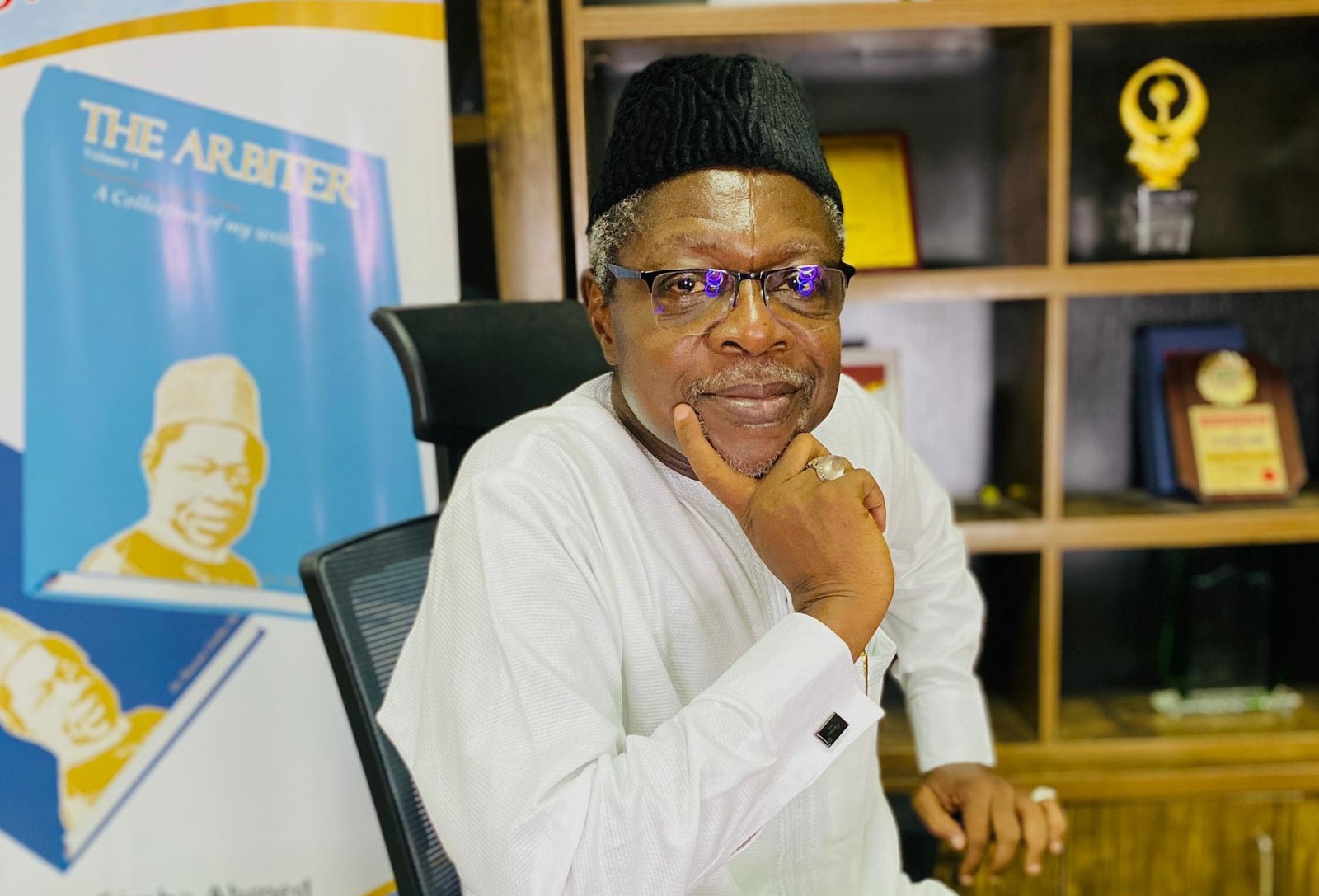
Hassan Gimba is the publisher and editor-in-chief of Neptune Prime,