It is a scientific fact that water and oil do not mix, but in the complex and complicated world of criminal enterprise, this natural law does not apply. It is becoming evident that in Nigeria’s crude oil theft industry , there is an inexplicable convergence of interest against the interest of the country. This has gone on for too long , hurting our economic calculations as a country.
A massive vessel, “MT Tura 11”, laden with 800 metric tonnes (erroneously stated as 800,000 litres) of stolen crude oil, was intercepted on Escravos Sea in Delta State by operatives of Tantita Security Services Limited. They handed over the vessel to the military Joint Task Force (JTF) Operation Delta Safe troops.
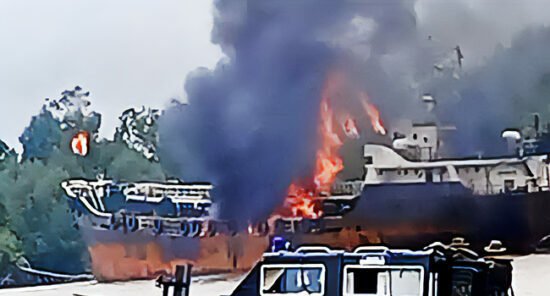
The JTF personnel allegedly set the bunkering vessel ablaze on Warri River after the ship’s captain confessed that the ship was laden with crude oil. Could the recent arrest and subsequent setting ablaze of a vessel used for oil theft be a case of a complex web of organised economic crime or failure of law enforcement? The facts of this case are as intriguing as the entire landscape of oil theft, maritime crime, and environmental degradation in the Niger Delta. This operation has caused considerable unease among stakeholders in the oil and gas industry, maritime space, law enforcement and ecological conservation activists. It raises a lot of fundamental questions with no answers in sight.
First, is the burning or destruction of vessels transporting stolen crude oil the best approach to fighting the crime? This entails destroying evidence that would aid investigation and prosecution. The hasty destruction of the oil theft vessel raises questions about due process in the fight against what may be considered a complex economic crime against the state. In every crime investigation system and process, the instant destruction of evidence leaves a trail of further suspicion.
There are elements of concealment of a wider crime that a more thorough and discreet investigation will reveal. This vessel had been arrested severally in connection with crude oil theft and released. We are unaware of any arrest and prosecution connected with these previous incidents. The JTF had, in October 2022, destroyed a vessel, MT Deima, allegedly carrying stolen crude. Burning vessels used for crude oil theft is now a common practice and a pattern of a deterrent.
The Defence Headquarters’ defence to this noxious practice is a certain executive order given by former President Olusegun Obasanjo in 2003. However, in 2019, facilitated by Nigerian Maritime Administration and Safety Agency (NIMASA), Nigeria’s National Assembly passed the Suppression of Piracy and Other Maritime Offences Act (SPOMO Act), which provided the legal framework to deal with this kind of issue, including provisions for asset forfeiture and disposal of proceeds.
Second, will burning crude oil at sea not exacerbate the already severe environmental degradation in the Niger Delta? Elementary science has taught us that it will lead to air and marine pollution, degraded mangroves, and oceans, and destroyed biodiversity and vegetation.
In this instance, the burning of 800 MT of crude, if it took place, will have far-reaching and long-lasting effects on the environment and the communities dependent on it. The cleaning up of the environment could take several weeks. While addressing the issue of stolen crude should remain crucial, environmental protection must remain a priority.
Third, on the issue of law enforcement, with multiple maritime intelligence gathering technology available in the country, such as Nigerian Navy’s “Falcon Eye”, NIMASA’s “C4i and NPA’s “C3i”, how come none was able to detect a tanker vessel as big as MT Tura 11 or MT Deima? Does it not raise curiosity that it took a security contractor rather than the Navy or other security agencies to intercept and arrest the rogue vessel? Is this a case of conspiracy, complicity or just abdication or dereliction of duty? When juxtaposed with the allegation of Mujahid Asari Dokubo of a compromised military, it calls for deep investigation, interrogation, and introspection.
There are obvious vested interests, and things are unravelling. And one wonders whether this operation has anything to do with the N48 billion per annum pipeline surveillance and security contract. Is there a “Wangerisation agenda” in the crude oil pipeline contract?
This incident provides an opportunity for a holistic review of our approach to fighting oil theft in the country. The criminal violation in oil theft has been a concern for years. This is despite the existence and presence of the Navy in the suspected theatres. Getting to the bottom of this criminal enterprise requires more than the arrest of one errant vessel. It requires a thorough investigation to establish the missing links between the arrested vessel and other activities in the past. As we already know, oil theft is a major national economic crisis that requires a deeper understanding and collaborative action as a national priority.
A few issues are for consideration. Should we not consider asset forfeiture and disposal instead of burning, which is barbaric, crude, unhealthy and toxic? Have we considered recovery and repurposing the stolen crude for legitimate use? What level of interagency collaboration do we have in the fight against crude oil thieves? From the overall layout of the narrative, it is obvious something is fishy.
Crude oil theft is a significant challenge in Nigeria, and tackling it requires a systematic and bespoke approach involving various stakeholders. We need to articulate some strategies to address this economic malady. Recognising that addressing crude oil theft requires a multi-faceted and sustained effort involving government agencies, law enforcement, communities, and international partners is crucial. Combining these strategies with continuous monitoring, evaluation, and adaptation of approaches can significantly reduce crude oil theft in Nigeria. Some of these strategies are in place now, but their functionality could be better since they have not eradicated the scourge of oil theft in Nigeria. Efficient and effective implementation is a crucial success factor.
Activities such as enhancing security measures in oil-producing regions are crucial. This includes increasing patrols, establishing dedicated security forces, and deploying technology such as surveillance systems and drones to monitor pipelines and oil infrastructure. Cooperation between the Nigerian Navy,NIMASA, the Nigerian Police, and other security agencies is essential to combat oil theft effectively. Besides, engaging with local communities in oil-producing regions is vital for addressing the root causes of crude oil theft. It is essential to create awareness about the negative impacts of oil theft on the environment, economy, and local livelihoods. Encouraging community members to report suspicious activities and offering alternative sources of income can help reduce the incentive for involvement in oil theft.
Also, protecting pipelines from tampering and illegal tapping is crucial. Implementing technologies like pipeline monitoring systems, pressure sensors, and leak detection systems can help promptly identify and respond to unauthorised activities. Regular inspections and maintenance of pipelines are necessary to ensure their integrity and reduce vulnerabilities.
Furthermore, strengthening legal frameworks and imposing stricter penalties for oil theft can act as a deterrent. Enforcing existing laws and regulations effectively, prosecuting perpetrators, and confiscating assets obtained through illegal activities can help combat oil theft. Also, enhancing governance and promoting transparency in the oil sector is essential to tackle oil theft. Implementing measures to curb corruption, improve revenue management, and ensure accountability in the oil industry can help reduce opportunities for theft and illegal activities.
Collaboration is key to effectively addressing crude oil theft in Nigeria. Collaborating with international partners to address the transnational nature of oil theft is crucial. Sharing intelligence, best practices, and technical expertise can help Nigeria in its efforts to combat oil theft. Cooperation with neighbouring countries to prevent smuggling and illegally exporting stolen oil is also important. Collaboration between oil companies operating in Nigeria and relevant industry associations is essential. These entities can share information and collaborate on security measures, technology implementation, and best practices to protect oil infrastructure. Cooperation can include exchanging information on suspicious activities and joint initiatives to address oil theft.
Besides, collaboration with technology providers specialising in pipeline security, surveillance systems, and monitoring technologies can significantly enhance efforts to tackle crude oil theft.
Finally, collaborating with financial institutions can help track and disrupt the financial networks associated with crude oil theft. Sharing information on suspicious transactions, implementing stricter financial controls, and working together to freeze and seize assets obtained through illegal activities can undermine the profitability of oil theft operations.
Establishing platforms for regular communication, coordination, and information sharing among these collaborating entities is important.
It is important to reiterate that strategies and actions of the past have not worked, and this new administration must desist from following them. Now is the time for a new bold approach to tackling the menace of crude theft. The systems that allow such impunity are entrenched and will be difficult to uproot. This calls for a deliberate intervention from Nigeria’s highest point of leadership. The President must send a clear message that he will not accept the stealing of even a drop of our crude oil, and those behind such atrocity must stop or face the wrath of the law no matter how highly placed they are. It is a national embarrassment for news of crude oil theft to pervade the local and international space. Nigeria must protect its resources at all costs.
ABOUT THE AUTHOR
Peterside, former DG at NIMASA, writes from Port Harcourt, Rivers State.