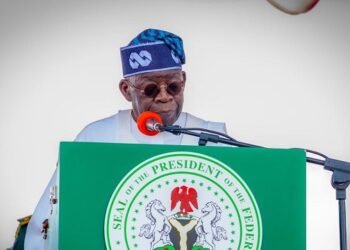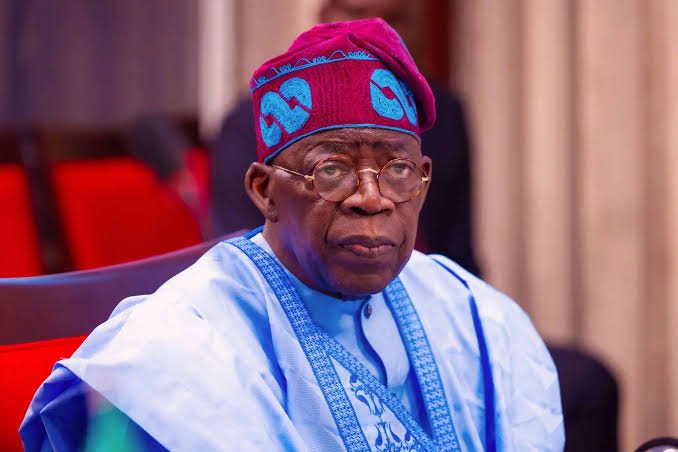
President Bola Tinubu did not leave anyone in doubt when he promised to significantly increase the revenue of the federal government under his administration. He set the tone on his first day in office.
During his swearing-in ceremony at the Eagle Square, in Abuja, on May 29, 2023, he declared, “Subsidy is gone.” Members of the public were shocked. As learnt later, even members of his inner caucus were equally shocked because nothing prepared them for the announcement.
However, President Tinubu stuck to his decision, especially as there was no major challenger of that critical decision which led to an unprecedented inflation in the country.
The president’s objective was to free more money for the government to be able to address socio-economic developmental issues in the country.
The exchange rate unification by the government weakened the Naira massively; but it raked in more money in Naira for the government.
The two major reforms were to save money for the government. They have. Several other reforms in the fiscal space – especially the tax reform expanded the tax base and has significantly increased tax revenue.
Data from the major revenue agencies indicate that the president has largely achieved his objectives of massively raising government revenue.
The Nigeria Customs Service (NCS) experienced significant revenue growth from 2023 through 2025. The agency collected ₦3.21 trillion in 2023, jumped to ₦6.1 trillion in 2024, and closed 2025 at an all-time high of ₦7.28 trillion, surpassing its annual target by ₦697 billion.
In 2024, the ₦6.1 trillion surpassed the ₦5.07 trillion target by 22%. Similarly, in 2025, the ₦7.28 trillion exceeded the ₦6.58 trillion target by 10%)
Tax and Reforms
The Federal Inland Revenue Service (FIRS), now National Revenue Service (NRS) collected record-breaking tax revenues between 2023 and 2025, culminating in a historic ₦47.39 trillion collected over the period from October 2023 to September 2025. This growth was heavily driven by aggressive, modernised tax administration and the non-oil sector, which accounted for roughly 76% of collection
In 2023, the NRS collected the sum of N12. 374 trillion. The following year, NRS was given a revenue target of N19.4 trillion but collected N21.6 trillion. Similarly, in 2025, it was given a target of N25.2 trillion and collected the sum of ₦28.3 trillion.
In September last year, President Bola Tinubu declared in Abuja that Nigeria had met its revenue target for 2025 by August, ahead of schedule and would no longer rely on borrowing to fund its budget.
He said that the bulk of the revenue came from the non-oil sector.
He said the 2025 revenue drive of his administration had yielded enough to meet the year’s projections by August, therefore, reducing the pressure for loans to fund its budget.
His words, “Today I can stand here before you to brag: Nigeria is not borrowing. We have met our revenue target for the year and we met it in August.”
President Tinubu’s declaration left much ambiguity as there is nothing like a budget for the entire Nigeria. The federal government budget does not represent Nigeria’s budget as each of the 36 states, with the Federal Capital Territory has its own budget.
Nigerian Govt Says States Awash with Cash, Yet Insist it has no money
Top officials of the present administration have said, severally, that states are awash with cash. Former Finance Minister, Mr. Wale Edun, said so at the 31st Nigerian Economic Summit (NES31) in Abuja.
He described the massive monthly allocations from the Federation Accounts to states as a major shift in Nigeria’s fiscal fortunes.
He said “states are now awash with cash”, positioning them to drive real growth and better service delivery at the grassroots.
Mr. Edun credited the leap in allocations to the unification of exchange rates and the removal of fuel subsidy, two of the most daring reforms of the Tinubu administration.
Recently at the opening of the NRS headquarters in Abuja, the Senate President, Senator Godswill Akpabio made a similar declaration.
Also, Vice President Kashim Shettima, earlier this month, said that following the series of reforms undertaken by the present administration, State Governments now have plenty of funds at their disposal.
“The critical reforms of Mr. President even extend to the matter of local government autonomy, and the earlier mentioned reforms led to a situation where our subnational governments are now awash with liquidity. Hardly does any of our states borrow for now, but with a repositioning of their balance sheets, we see an opportunity for states to leverage their good standing and combining their current liquidity, we hope to see an explosion of local and rural infrastructure all over the country,” he said.
Words Now Contradicted
However, facts on ground show that not only has the Federal Government intensified borrowings, it is even unable to meet a lot of its financial obligations.
Until very recently, protesting pensioners and contractors were regular visitors at the gate of the Federal Ministry of Finance in Abuja. Sometimes, the protesters block the main gate for several days, insisting to be paid their entitlements or for jobs done for the government.
Another evidence of the government’s financial strain is the poor capital budget implementation almost every year, despite claims of huge revenue inflows.
For instance, the FG Capital Budget implementation in 2024 was only about 25 per cent due to paucity of funds. The government said its capital expenditure performance was much higher in 2024. For 2025, 70 percent of the Capital Budget was rolled over into 2026 and still running.
The government first extended the 2025 budget implementation to March 31, 2026, then further extended it to June 30, 2026.
Later the government announced that 30 percent of the capital budget would be implemented till November 2026.
Multiple Budgets
One thing this administration has got very wrong is to implement multiple budgets simultaneously.
At a point in 2025 there were as many as four FG budgets being implemented at the same time. There was the original 2025 Budget, then the Supplementary Budget of the year, the 2024 Budget, the 2024 Supplementary Budget were all running concurrently, making it impossible for analysts, including media and Civil Society Organisations (CSOs) to track or monitor the budgets.
At the beginning of 2026, the government vowed to clean up the budgeting system and the unhealthy implementation of several budgets at the same time.
However, this has not happened as the 2025 FG budget which was extended to June 2026 is still being implemented, while the 2026 budget is also being implemented. So much for successes recorded in three years!