


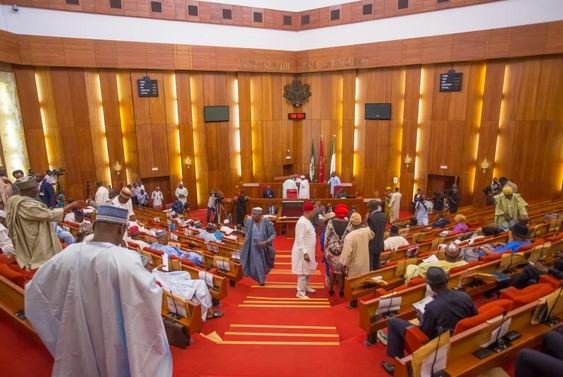
The Foreign Aid Bill currently pending in the Senate completely lacks merit and should consequently be withdrawn or struck out. Titled the *Foreign Aid (Regulation, Coordination, Transparency and Disclosure of Foreign Aid, Grants and Donations) Bill, 2026 (SB. 1034)*, the Bill, inter alia, seeks to regulate and monitor funds received from abroad by NGOs, civil-society organisations, churches and charitable organisations.
The extant Bill originates from the Senate. It is sponsored by Senator Ibrahim Hassan Dankwambo (PDP, Gombe North). Before entering the Senate, Senator Dankwambo served as Governor of Gombe State from 2011 to 2019. He had also served as Accountant-General of the Federation before becoming governor.
Senator Dankwambo’s Bill passed second reading on July 22, 2026, and was subsequently referred to Senate committees for further consideration. At the time of writing, no date has been fixed for the public hearing on the Bill.
As I stated earlier, the Bill completely lacks merit. This explains why not fewer than 90 international, African and Nigerian civil and human rights organisations are reportedly vehemently opposed to it and have urged the National Assembly to withdraw it immediately. According to them, the Bill is capable of stifling churches, church-owned universities, Islamic institutions, charitable and faith-based organisations, NGOs, civil-society organisations and humanitarian groups working in Nigeria.
*Prima facie*, the Bill appears laudable. However, its provisions, when examined closely, raise serious constitutional and public-policy concerns. The Bill purports to promote transparency, accountability and coordination in the receipt and utilisation of foreign aid.
Those are undoubtedly legitimate objectives. Yet, beneath these noble declarations lies an elaborate regulatory architecture that could unnecessarily burden, intimidate and potentially undermine legitimate NGOs, civil-society organisations, religious bodies, educational institutions, charitable organisations and humanitarian organisations.
Why, therefore, does Nigeria need another agency—the proposed Foreign Aid Regulatory Commission (FARC)—to police every entity receiving foreign aid?
The proposed law would require recipients of foreign aid to register with the Commission within 30 days of receiving such aid. Failure to register would constitute an offence. Recipients would also be required to disclose the source and amount of the aid, its purpose and conditions, details of implementing partners, and periodic reports on its utilisation. The Commission would have powers to demand information, conduct audits and inspections, impose administrative sanctions and issue regulations.
More importantly, Senator Dankwambo’s Bill raises serious questions concerning the constitutional rights to personal liberty, privacy, freedom of thought, conscience and religion, freedom of expression, freedom of movement, freedom from discrimination, and freedom of peaceful assembly and association, as guaranteed under *sections 35, 37, 38, 39, 40, 41 and 42 of the 1999 Constitution*.
If the government suspects that a particular NGO, church, mosque, charitable organisation or civil-society organisation operating in Nigeria is being used as an instrument of fraud or other criminal activity, it should invoke the existing laws against such an organisation. What the government cannot legitimately do is gag or emasculate civil-society organisations and NGOs under the pretext of regulating them.
I am a senior Nigerian legal practitioner. I know that Nigeria does not suffer from a shortage of laws regulating financial transactions, charities, incorporated trustees, universities, companies, money laundering, taxation, public expenditure and the activities of non-governmental organisations.
The country already has regulatory institutions such as the Corporate Affairs Commission, the Nigerian Financial Intelligence Unit, the Economic and Financial Crimes Commission, the Independent Corrupt Practices and Other Related Offences Commission, the Federal Inland Revenue Service, the Central Bank of Nigeria and other relevant regulatory bodies. Universities, incorporated trustees, companies and charitable organisations are already subject to various reporting, auditing and financial obligations.
What Nigeria presently lacks is enforcement of existing laws.
Why this Bill? By virtue of their registration under the Companies and Allied Matters Act, 2020 (CAMA), church-based NGOs, civil-society organisations, charitable organisations and faith-based institutions operating in Nigeria already possess legal recognition to operate in the country. CAMA also provides a framework for the regulation, supervision and monitoring of incorporated trustees and other organisations within its scope.
The combined effect of the provisions of Senator Dankwambo’s Bill is to emasculate or gag the operations of church-based NGOs, charitable organisations, faith-based institutions and civil-society organisations working in Nigeria, thereby stifling their effectiveness.
So, why sponsor a bill capable of killing or strangulating Civil society, Church NGOs, faith-based organizations and charitable organizations when there are existing laws regulating them? This is unfortunate.
There is therefore no compelling justification for imposing another layer of governmental control on these organisations merely because they receive legitimate assistance from foreign partners.
More troubling is the Bill’s extraordinarily wide application. It covers not only federal and state institutions but also NGOs, civil-society organisations and private entities receiving foreign aid. “Foreign aid” itself is defined broadly to include financial or technical assistance from foreign governments, international organisations and private foreign entities. Such a definition could potentially sweep into the regulatory net a vast range of perfectly legitimate activities.
Consider *Babcock University, established by the Seventh-day Adventist Church; Veritas University, Augustine University, Godfrey Okoye University, Caritas University, Dominican University, Spiritan University, Madonna University and Shanahan University, associated with the Catholic Church; Bowen University, associated with the Nigerian Baptist Convention; Covenant University and Landmark University, established by the Living Faith Church Worldwide; Redeemer’s University, established by the Redeemed Christian Church of God; and Ajayi Crowther University, associated with the Church of Nigeria, Anglican Communion*.
Consider also *Pan-Atlantic University, Benson Idahosa University, Joseph Ayo Babalola University, Crawford University, McPherson University, Mountain Top University, Evangel University, Anchor University, Samuel Adegboyega University, Hezekiah University, Salem University, Rhema University, University of Mkar, Wesley University, Precious Cornerstone University and Glorious Vision University*
The Muslim community has equally contributed significantly to higher education in Nigeria. Consider *Islamic and Muslim-owned universities such as Al-Hikmah University, Ilorin; Al-Qalam University, Katsina; Crescent University, Abeokuta; Fountain University, Osogbo; and Summit University, Offa*.
There are also *Muhammad Kamalud-Deen University, Ilorin, established by the Ansarul-Islam Society of Nigeria; Rayhaan University, Birnin-Kebbi, associated with the Khadimiyya for Justice and Development Initiative; Huda University, Gusau, associated with the Huda Educational Foundation; and Al-Bayan University, Ankpa*, associated with the Al-Bayan Foundation.
Beyond faith-based organisations are major humanitarian organisations such as the *Nigerian Red Cross Society, Save the Children, ActionAid, Oxfam, CARE, Mercy Corps, World Vision, Plan International and Christian Aid* among others.
Many of these Universities and institutions receive grants, scholarships, research funding, academic assistance and donations from overseas universities, religious congregations, charitable foundations and other international partners. Catholic hospitals and humanitarian organisations similarly receive international assistance to provide healthcare, education, poverty alleviation and emergency relief.
Are such institutions now to be treated as potential instruments of foreign influence simply because some of their legitimate charitable or educational funding originates abroad? That would be an absurd consequence.
Foreign funding does not automatically mean foreign interference. A grant from an overseas Catholic foundation to a Catholic university to establish a laboratory is not, merely because of its foreign source, a threat to Nigeria’s sovereignty. A donation from an international charity to a Catholic hospital to provide healthcare to indigent Nigerians is not foreign political intervention. A scholarship funded by an overseas religious institution is not a security threat.
Indeed, international cooperation in education, healthcare, humanitarian assistance and social development is a normal feature of the modern world. Senator Dankwambo’s Bill risks confusing transparency with control. Nobody should oppose transparency. Foreign-funded organisations must account for money entrusted to them. Where there is evidence of money laundering, terrorism financing, corruption, diversion of funds or other criminal conduct, existing Nigerian laws should be vigorously enforced.
But, as I said earlier, Nigeria has enacted enough laws to address these problems. The problem is enforcement, not the absence of laws. Nigeria already has *the Corporate Affairs Commission, Central Bank of Nigeria, Federal Inland Revenue Service, Economic and Financial Crimes Commission, Nigeria Financial Intelligence Unit and other regulatory institutions*. NGOs and charitable organisations are already subject to registration, reporting and financial obligations.
If an NGO fraudulently diverts donor funds, the authorities should prosecute it under existing laws. If a charity launders money, the appropriate anti-money-laundering institutions should act. If a company commits fraud, the relevant criminal and regulatory laws should apply. If a university misappropriated grant money, it should be held accountable.
Creating another commission will not magically make Nigerian institutions more accountable. It may instead create another bureaucratic layer, another database, another registration requirement, another inspection regime and another opportunity for administrative bribery, oppression and abuse of office.
There is also a troubling provision in Senator Dankwambo’s Bill requiring foreign-aid-funded projects to align with Nigeria’s national development plans and priorities. This may sound reasonable until applied to universities, churches and independent civil-society organisations.
Must *Al-Qalam University, Katsina; Crescent University, Abeokuta; Fountain University, Osogbo; Summit University, Offa; Muhammad Kamalud-Deen University, Ilorin, or a Catholic, Baptist or Seventh-day Adventist university* obtain governmental approval for a research project simply because an overseas institution is funding it?
Must an independent humanitarian organisation demonstrate that every charitable project conforms to whatever happens to be the government’s prevailing development priorities? What happens when a civil-society organisation’s legitimate assessment of Nigeria’s social problems differs from the government’s position?
Under successive APC administrations of Muhammadu Buhari and Bola Ahmed Tinubu, Nigerians have witnessed repeated attempts to introduce new regulatory mechanisms strangulating NGOs and civil-society organisations. For example, in 2016, the then Deputy Majority Leader of the House of Representatives, Hon. Umar Buba Jibril, sponsored an NGO Regulatory Commission Bill in the House of Representatives. The proposal sought to establish a regulatory framework for NGOs and civil-society organisations in Nigeria. It passed second reading and generated substantial opposition before ultimately failing to become law.
Hon. Jibril died on March 30, 2018. *May his soul rest in peace*
In 2019, the then Speaker of the House of Representatives, Femi Gbajabiamila, indicated that lawmakers intended to revisit the question of NGO regulation, citing concerns about NGO activities, particularly in the North-East.
*Now, seven years later, another Bill has emerged—this time in the Senate and under a different sponsor*.
The present Bill sponsored by Senator Dankwambo is not identical to Hon. Umar Buba Jibril’s earlier proposal. However, there are sufficient similarities in their regulatory approach to warrant public scrutiny and comparison.
Nigeria appears to be witnessing yet another attempt to tighten the regulatory grip of government over civil-society organisations, charitable bodies and institutions that receive foreign assistance.
Why create another elaborate regulatory architecture when Nigeria already has institutions and laws capable of supervising financial transactions, taxation, corporate registration, money laundering, terrorism financing and charitable organisations? Why revive a failed idea in another form? Why should legitimate civil-society organisations, religious institutions and charities be subjected to another layer of governmental control merely because they receive foreign assistance?
This is particularly important because an independent civil society is indispensable to democracy. NGOs, charities, professional organisations, religious bodies and advocacy groups often provide the scrutiny that government institutions themselves cannot provide. Why should organisations receiving legitimate foreign grants require another layer of governmental approval when existing financial and corporate regulatory institutions already monitor their activities?
Nigeria needs more philanthropy, not less. It needs more universities, hospitals, charities and humanitarian organisations—not laws that make their operations unnecessarily difficult. Civil-society organisations, universities, churches, Islamic organisations, lawyers, accountants, development partners and ordinary Nigerians should be allowed to operate within the law without unnecessary bureaucratic obstacles.
Civil society is not an extension of government. Churches are not departments of government. Universities are not ministries. Humanitarian organisations are not political agencies of the state. Their independence is part of the architecture of a democratic society.
Nigeria’s perennial problem is not that it lacks agencies. It is that existing agencies frequently lack the capacity, coordination, independence or political will to enforce the laws already on the books.
The Senate should learn from the failure of the Jibril NGO Bill. It should not attempt to legislate merely for the sake of legislating. Where existing laws are adequate, the answer is to enforce them not to legislate for the sake of legislating.
All said, Senator Dankwambo’s bill lacks merit and should be withdrawn or struck out.
ABOUT THE AUTHOR:
Ekwowusi, a legal practitioner, is a member of the Editorial Board of The Guardian newspaper


