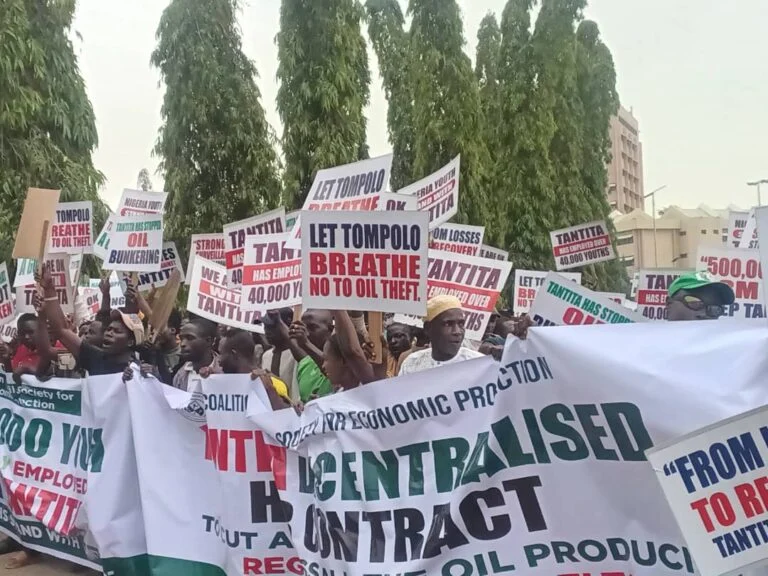
Scores of demonstrators staged a protest on Wednesday at the National Assembly, as lawmakers intensified deliberations on crude oil theft and pipeline security in Nigeria’s oil-rich Niger Delta.
The protesters, under the aegis of the Coalition of Civil Society for Economic Protection, marched to the legislative complex, chanting solidarity songs and waving placards bearing inscriptions such as “Oil thieves Are Conspiring Against Tantita” and “Say No to Oil Bunkering.”
They were, however, prevented from gaining access to the premises by security personnel, including officers of the Nigeria Police Force and other security agencies.
The protest comes amid heightened legislative attention on oil theft, which has long undermined Nigeria’s crude oil output, depleted government revenue, and fuelled insecurity in host communities.
Addressing journalists during the protest, the convener of the group, Tesleem Kolawole, urged lawmakers not to compromise on pipeline security and the future of the Niger Delta.
He said, “We call on the lawmakers to sincerely and holistically look at the journey of Tantita from when they started securing the country to date, without fear or favour. They should examine the modus operandi of the contract and its primary aim to determine whether it has been successful or not.
“The conversation around pipeline surveillance must be guided by results, because when national assets are secured, the economy benefits, communities stabilise, and young people gain real opportunities.
“In that regard, Tantita Security Services Nigeria Limited has become a visible part of a broader national effort that has helped restore confidence in pipeline security and crude oil production.”
Continuing, Kolawole stated that Nigeria’s oil production has recorded a significant rebound, rising to about 1.8 million barrels per day in November 2024, according to available statistics.
This, he said, marks a sharp recovery from previous lows of around 500,000 barrels per day before Tantita Security Services’ engagement in 2022, when widespread vandalism and criminal activities severely hampered output.
“So our message here today is simple. This is not the time to weaken a framework that has helped restore production, support youth enterprise, improve education, and create alternatives to criminality.
“This is the time to strengthen accountability, improve coordination, and protect what is working. When a programme produces measurable gains in oil security, education, skills, agriculture, and youth engagement, the responsible thing is not disruption; it is consolidation.
“Therefore, we call for continuity, transparency, and support for every initiative that secures national assets while also lifting people. Tantita’s record, as publicly reported, shows that security and development can work together. That is the standard we should protect for Nigeria’s future,” he added.
Crude oil theft remains one of Nigeria’s most pressing economic challenges, with successive governments adopting a mix of military operations and private surveillance contracts to curb pipeline vandalism and illegal bunkering.
The ongoing parliamentary engagement is expected to shape future policy direction on securing the country’s oil infrastructure.