
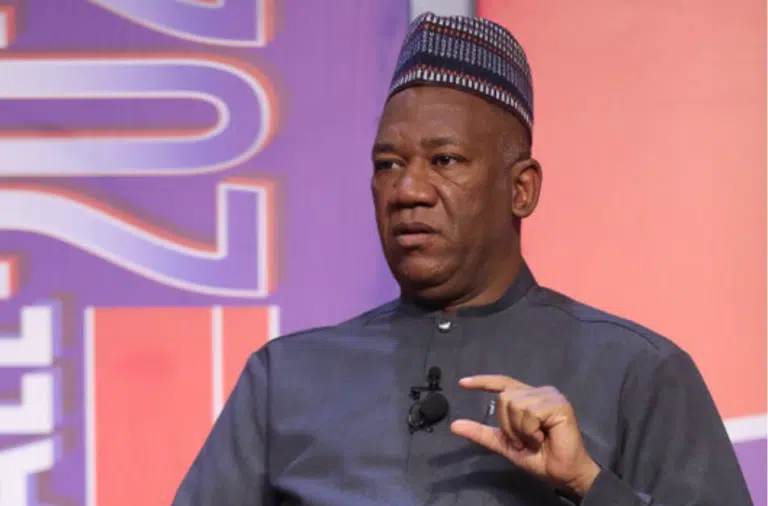
Former Labour Party vice-presidential candidate in the 2023 presidential election, Yusuf Datti Baba-Ahmed, has said none of the politicians currently positioning themselves to challenge President Bola Ahmed Tinubu in 2027 can deliver the kind of change Nigeria needs, including his former running mate, Peter Obi.
Baba-Ahmed made the remarks during an appearance on the Mic On Podcast, where he discussed the emerging political alignments ahead of the 2027 presidential election.
“None of the people running against President Tinubu can change the country,” Baba-Ahmed said.
Asked whether his assessment also applied to Obi, whom he contested the 2023 election alongside on the Labour Party ticket, Baba-Ahmed gave a direct response: “Including Peter Obi.”
The comment comes amid heightened political activity ahead of the 2027 general election. Obi is currently the presidential candidate of the Nigeria Democratic Congress (NDC), while Baba-Ahmed is with the Peoples Redemption Party (PRP).
Baba-Ahmed had previously explained that his decision to serve as Obi’s running mate in 2023 was driven largely by sympathy for the former Anambra State governor and concern about the political support he was receiving at the time.
Speaking in June during an interview with Symfoni, Baba-Ahmed said Obi had approached three prominent politicians in 2022 in an effort to build a political alliance, but they allegedly declined to join him.
“They thought I would follow Peter Obi,” Baba-Ahmed said.
“People don’t understand between me and Peter Obi, I have a great deal of sympathy for him. And this sympathy was at the core of our relationship.”
He said the decision by the politicians to stay away from Obi’s movement left him disappointed, both for Obi and for the country, prompting him to volunteer himself for the project and eventually accept the vice-presidential candidacy.
“When he approached three major politicians in 2022 they avoided him. I would have been glad if in 2022 one of them went with Peter Obi. They all avoided him. I felt bad for him and for Nigeria as a nation,” he said.
Baba-Ahmed said he understood the reasons behind their decision but declined to disclose their identities or the specific circumstances surrounding their refusal to work with Obi.
He also rejected the suggestion that his political decisions would remain tied to Obi’s choices following the 2023 election.
“They thought I would follow Peter Obi to ADC, but I had given enough sympathy then. Obi does not own me. I own my independence,” he said.
The former Labour Party vice-presidential candidate has also expressed reservations about the ability of opposition politicians to build a strong and sustainable political alternative to the ruling All Progressives Congress ahead of 2027.
In May, he raised concerns about the prospects of opposition candidates securing broad support in northern Nigeria, arguing that regional influence, political structures, electoral calculations and the personalities involved would play significant roles in determining the outcome of the next presidential election.
“It is very unlikely that the North will rally around OK. That is my personal opinion,” he said.
Baba-Ahmed recalled meeting Obi in January 2024 at the John Wilson Hotel, where he said he advised him to engage prominent northern politicians, including former Kano State Governor Rabiu Musa Kwankwaso and former Kaduna State Governor Nasir El-Rufai, as part of efforts to build a wider political coalition for 2027.
“At that time, I told him there are key figures like Rabiu Musa Kwankwaso and Nasir El-Rufai. I suggested he should engage them,” he said.
He stressed that opposition politicians needed to begin building political alliances well ahead of an election rather than waiting until the election year.
“If in 2024 you cannot plan for 2027, then I cannot continue to be with you,” Baba-Ahmed said.
He also questioned some of the emerging opposition alliances, particularly where politicians who did not support particular candidates during the 2023 election were subsequently seeking to work together ahead of 2027.
“What changed between 2022 and 2023?” he asked.
Baba-Ahmed further argued that calls for a new generation of political leadership should be reflected in the age, experience and political profile of those being considered for presidential tickets.
“You are looking for new blood, a new generation, yet you may have a vice-presidential figure who is older in age, education, political profile, and experience,” he said.
He cited Kwankwaso’s political influence in northern Nigeria as an example of the kind of grassroots structure and regional strength that could significantly affect the balance of power within any opposition coalition.
“The local government is almost his state; the state is almost his region. And this is someone with strong ambition and temperament, who, then, will actually be the president?” Baba-Ahmed asked.
Credit: CityNewsNG


