
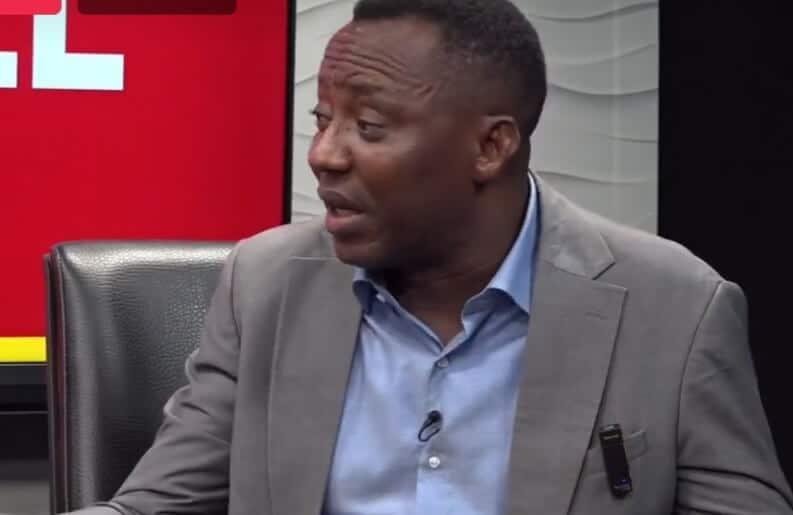
Omoyele Sowore has spent much of his public life presenting himself as a permanent victim of power. Every confrontation with authority becomes persecution, every court appearance becomes a stage, and every allegation against him becomes proof that the state fears his voice. That routine has served him for years, but recent proceedings before the Federal High Court in Abuja have made the contradiction harder to ignore.
Democracy gives citizens the right to criticise government, oppose power, and mobilise public opinion. That right must remain protected, especially in a country where public institutions still carry public mistrust. Yet democratic freedom also carries discipline. The right to criticise government does not create a right to damage reputations, and the right to oppose authority does not place any citizen above the law.
Sowore’s public life has always drawn strength from agitation. From student union politics at the University of Lagos to his later years as the founder of Sahara Reporters, he cultivated the image of a man permanently at war with authority. That posture may have mattered in the past, but he has refused to mature. Even after founding a political party and contesting presidential elections, he still clings to the habits of street confrontation, behaving as though activism should exempt him from the restraint, evidence and discipline expected of anyone seeking public power. He wants the moral authority of activism, the protection claimed by journalism and the legitimacy of party politics, while resisting the responsibilities that come with all three.
That weakness is at the centre of the criminal charge brought against him by the Department of State Services over his alleged description of President Bola Ahmed Tinubu as a “criminal” on social media. On 8 May 2026, Justice Mohammed Garba Umar dismissed Sowore’s no-case submission and held that the prosecution had established a prima facie case sufficient to require him to enter his defence. That ruling did not convict him. It rejected his argument that there was no case to answer and confirmed that the matter deserved a defence rather than an early termination.
A serious democracy must not treat accusation as conviction. Sowore remains entitled to his defence, fair proceedings and every protection the law gives an accused person. But he cannot turn the existence of a legal process into automatic evidence of repression. Courts exist to test claims, weigh evidence and determine whether speech has crossed a lawful boundary. A citizen who demands accountability from others cannot treat accountability as tyranny when the process turns toward him.
The April 2026 judgment in his rights suit against the DSS, its Director-General and Meta Platforms made the issue clearer. Sowore had challenged the reported takedown of his Facebook post and the deactivation of his account, claiming that his rights to fair hearing, expression and association had been violated. The Federal High Court dismissed the suit, declined his reliefs and awarded costs of N1.5 million against him. The court held that the complaint made to Meta did not violate his fundamental rights, and that freedom of expression may be curtailed where necessary to protect the rights and reputation of others.
That ruling goes to the heart of the matter. Rights do not exist in isolation from the rights of others. The Constitution protects expression, but it also allows lawful limits in the interest of public order, morality, security and reputation. A person cannot casually brand another person a criminal in the court of public opinion and then retreat into constitutional language when asked to justify the statement. Democracy protects robust criticism, but it does not require society to treat reputational harm as a harmless by-product of activism.
Sowore’s courtroom conduct also reveals the same instinct. In March 2026, the Nigerian Bar Association criticised him after an attempted media briefing inside a Federal High Court courtroom in Abuja. Reports said a Senior Advocate of Nigeria objected, and the NBA later stated that courtrooms are open to the public, but not as arenas for performance. Sowore rejected the NBA’s position and accused the association of selective outrage. That response was revealing. Even when the issue concerned courtroom dignity, he treated correction as hostility.
The pattern is: every arrest of alleged lawbreakers becomes a campaign opportunity, every institutional rebuke becomes a conspiracy, and every court process becomes material for martyrdom. Sowore has mastered the politics of turning procedure into spectacle. That style may excite supporters, but it weakens public reasoning. It teaches younger citizens that insult is courage, accusation is evidence, and institutions deserve respect only when they produce favourable outcomes.
His defenders often collapse the distinction between free speech and reputational injury. They frame every response to him as an attack on dissent. Free speech includes the right to criticise a President, expose public failure, challenge institutions and mobilise citizens. It does not excuse the need for evidence when a person makes grave personal allegations, turn social media into a court of law, or make any political actor too important to be sued, prosecuted, questioned or corrected.
This matter is beyond Sowore. Nigeria already suffers from a public culture where noise often defeats substance, allegations outrun facts, and outrage earns more reward than discipline. The state must not criminalise dissent or use security agencies to settle political discomfort. Activists and opposition figures must not convert democratic freedoms into tools of reputational violence. Both impulses damage democracy.
The strongest defence of democracy is equal accountability. Everyone must live under the same constitutional order. That order allows criticism but protects reputation, permits dissent but demands evidence, and recognises opposition without rewarding defamation as courage. Sowore has the right to oppose the government, contest elections, publish unfavourable stories and test public institutions. But he also has the duty to defend his words when they carry legal consequences.
For too long, Sowore thrived on the confusion between dissent and disorder. He has treated provocation as proof of conviction and institutional response as proof of victimhood. That habit has brought him attention, but attention is not credibility. If Sowore has evidence for his claims, the courtroom gives him a lawful venue to present it. If his words were fair comment, his defence can argue so. If his politics depends on making grave claims without bearing the burden of proof, then the issue has moved beyond activism to impunity. Democracy protects Sowore’s right to speak, but it does not owe him freedom from the burden of defending his words.
ABOUT THE AUTHOR:
Okoroafor is an Abuja-based Public Affairs Analyst


